For decades, global hunger was on the decline. But now, due to conflict, climate change, global inequality, and other factors, famine has returned.
The Definition of Famine
Famine is the most severe and catastrophic form of hunger crisis, resulting from extreme food shortages. It is very rare, but when it does occur, it means that there is an extreme shortage of food and that several children and adults within a certain area are dying of hunger on a daily basis.
Unlike deadly emergencies such as earthquakes or other natural disasters, famines arise gradually due to long-term drivers like conflict, climatic shocks, deep poverty, and inequality. Famines are never inevitable – they are always predictable, preventable, and man-made.
Conditions That Define Famine
Famine is a technical term declared when three criteria — food insecurity, acute malnutrition, and mortality rates — have met or surpassed certain thresholds. Together, the three conditions signal a humanitarian emergency where thousands may die within weeks without immediate large-scale intervention.
1. Food Insecurity Threshold
At least 20% of households in the affected area are classified as IPC Phase 5 (Catastrophe). Families have virtually no access to food and face starvation.
2. Acute Malnutrition Threshold
At least 30% of children under age 5 suffer from acute malnutrition (wasting). Wasting occurs when children are dangerously thin for their height, reflecting severe and recent undernutrition.
3. Mortality Threshold
The death rate per day exceeds 2 deaths per 10,000 people overall or 4 deaths per 10,000 children under five. These mortality levels reflect widespread starvation, disease outbreaks, and the complete collapse of local food systems.
Toby Madden
Action Against Hunger, Mali
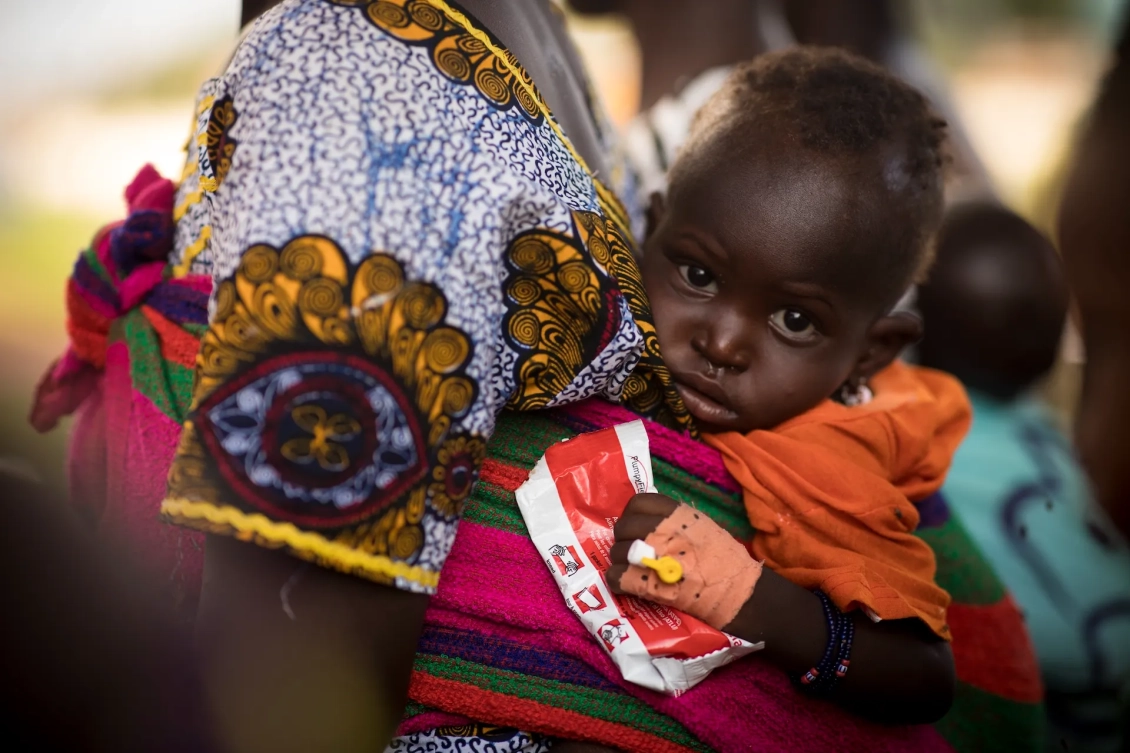
A child, carried by his mother, holds a packet of nutrition treatment.
How Is Famine Declared?
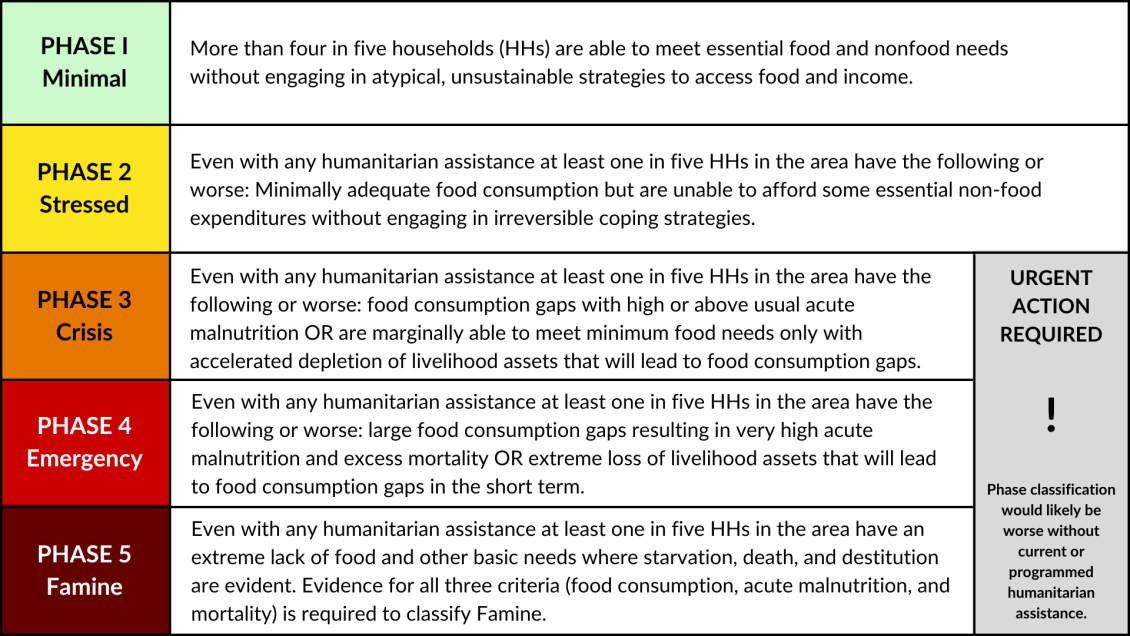
Famine declarations rely on the Integrated Food Security Phase Classification (IPC), an internationally recognized framework for classifying and identifying hunger crises. According to this framework, crises can be classified into one of five phases, from Phase 1 (Minimal) to Phase 5 (Catastrophe/Famine) — the worst-case scenario, with an extreme lack of food that causes starvation, destitution, and death.
The five integrated phase classifications (IPCs).
The key to understanding food emergencies is data. Action Against Hunger is one of 21 IPC partners with expertise in food security and malnutrition who gather information on food availability, malnutrition levels, and mortality rates. After all the data is collected, IPC partners, governments, UN agencies, and other stakeholders work together in groups— using the IPC’s scientific standards and analytical approach — to classify the severity and magnitude of food crises in a country.
If a country, or part of a country, meets famine criteria, then each member of the country’s IPC Technical Working Group must reach a consensus on these findings before famine is declared. To support technical consensus-building and quality assurance, the Famine Review Committee, a neutral, independent committee of technical experts, is activated to review IPC analysis findings of famine.
Before and after a famine is declared, the goal of the IPC system is to trigger action to prevent hunger crises from deteriorating further and to save lives. Though it is a very helpful tool, the system is not perfect. Data can be difficult to collect because the same conditions that cause hunger (i.e., conflict) are the ones that make it incredibly difficult to gather the data needed to determine if famine is occurring. Even after collection, data aggregation and technical consensus-building can be time-consuming processes. We cannot wait for formal declarations of famine to take serious action — not when families’ lives are at stake.
Drivers: Why Does Famine Happen?
The planet produces enough food to feed everyone on earth, and yet more than 231 million people are expected to face high levels of acute food insecurity this year, according to the 2025 Global Report on Food Crises. There are a variety of causes of hunger that can all contribute to famine when present for a long time, especially in combination with each other. Drivers can include:
Conflict — the leading driver of famine, which disrupts harvests, impedes humanitarian access, and forces families from their homes.
Climate shocks — droughts, floods, and extreme weather destroy livelihoods, reduce crop yields, and contaminate water sources.
Poverty & inequality — millions cannot afford nutritious diets, even when food is available.
Political decisions — there must be informed decision-making and political will to act before a hunger crisis reaches the stage of famine.
Conflict Drives Hunger Crises
Conflict is the top driver of hunger. Violence and insecurity put civilians in danger, while making it unsafe for humanitarians to assess the severity of a food crisis and to reach communities most in need of support. Sadly, this means that there are times when famine is suspected – even likely – but there is not enough information to confirm it.
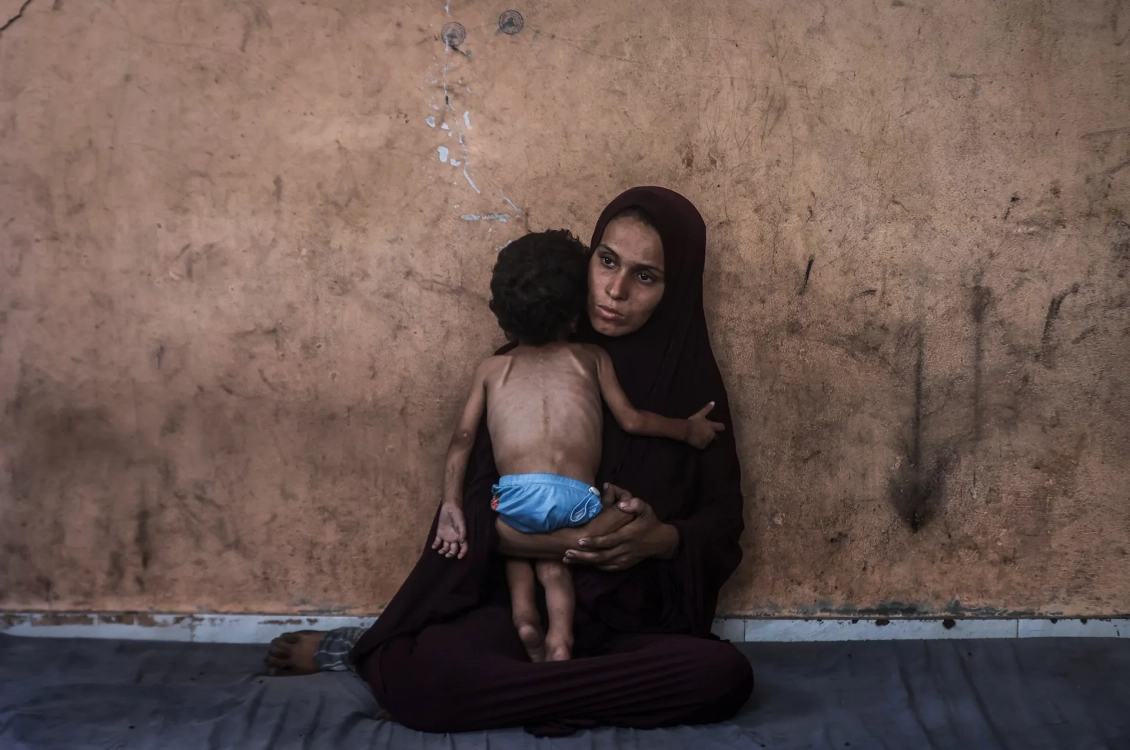
Famine was declared in Gaza on August 22nd, 2025. Over 500,000 people are facing catastrophic conditions, including starvation, destitution, and death. Local food production is nearly impossible, with only 1.5% of Gaza’s cropland accessible and undamaged. Inflation has driven staple food prices up by 4,000 percent, too expensive for most households to afford. In July and August alone, Action Against Hunger nutrition teams received more than 400 cases of malnourished children, 20% of them severe, and numbers are rising. Despite these alarming figures, humanitarian access remains severely restricted below what is needed to meet the needs of the population. An immediate ceasefire and unhindered, large-scale humanitarian response are essential to avert further loss of life in Gaza.
Getty Images
Action Against Hunger, Gaza
A woman holds a severely malnourished child in Gaza.
Sudan
Sudan has been experiencing the most extreme hunger crisis globally with ongoing famine and 21.2 million people—45 percent of the population—facing high levels of acute food insecurity (IPC Phase 3 or above) as of September 2025. A civil war that began in 2023 between the Sudanese Armed Forces and a military group, the Rapid Support Forces, has destroyed much of the country’s infrastructure and farmland and left about 25 million people in need of humanitarian assistance. The UN reported in June 2024 that both sides of the conflict were using starvation of civilians as a weapon of war.
Famine was formally declared by the Famine Review Committee in parts of North Darfur like the Zamzam camp for Internally Displaced Persons in July 2024. This was followed by an IPC analysis in November 2025 that confirmed the existence of famine in El Fasher and Kadugli and warned of imminent risk of famine in 20 additional areas of Sudan. Response to the crisis has been deeply insufficient. Support from the international community is urgently needed to end the war and provide a sufficient humanitarian response.
AFP
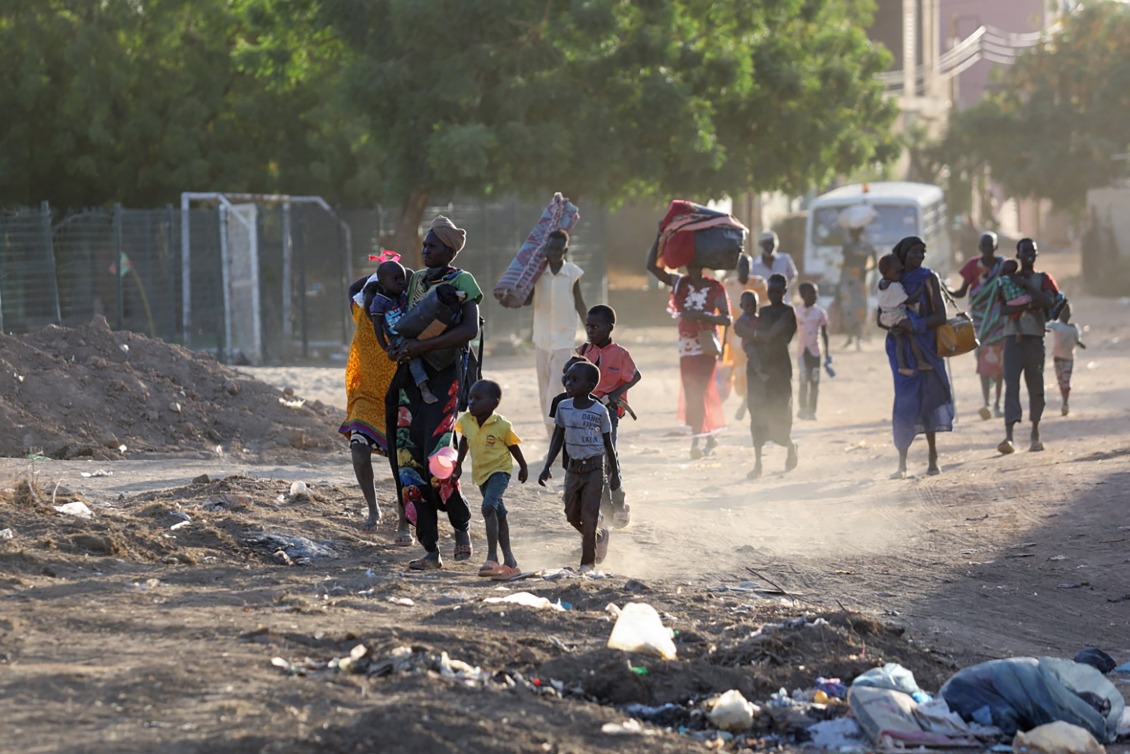
People flee their neighborhoods amid fighting between the army and paramilitaries in Khartoum on April 19, 2023, following the collapse of a 24-hour truce.
How We Respond: Action Against Hunger’s Approach
Life-saving nutrition — we operate and support health clinics and therapeutic feeding units specialized in treating severely malnourished children.
Emergency assistance — we deliver food, clean water, cash transfers, and other relief items swiftly.
Research & innovation— we conduct food security, nutrition, and impact surveys to provide empirically based, data-driven analysis and recommendations.
Advocacy — our teams push for humanitarian access and advocate to world leaders for urgent action.
Integrated solutions — many of our programs combine a variety of solutions like nutrition, health, livelihoods, WASH (Water, Sanitation & Hygiene), emergency response, research, and advocacy for a holistic response that prevents famine from happening or builds resilience to keep it from returning.
How we help communities facing famine
We provide lifesaving treatment to severely malnourished children and delivering emergency cash, food, and clean water. Our teams also help to assess the severity of food crises by surveying communities and supplying and analyzing data.
Our teams also research better ways to understand, prevent, and address hunger crises, advocate for greater humanitarian access to communities in need, and push world leaders to take action to create a world free from hunger.
Q1: What is the difference between hunger, malnutrition, and famine?
Hunger is when people experience distress from a lack of access to food.
Malnutrition is a medical term used in cases of undernutrition (missing calories or nutrients) or overnutrition (overconsumption).
Famine is a formal classification term used to signal a catastrophic level of hunger in an area based on strict IPC criteria.
Q2: Can famine be prevented?
Yes. Famines are not natural disasters—they result from human-made factors. For months before a famine is declared, the United Nations, humanitarian organizations, and other actors warn of deteriorating humanitarian crises. With early warning systems, proactive response, and political will, famine can always be avoided.
Q3: Why are children especially vulnerable during famines?
Children under five are at greatest risk because their bodies and immune systems are still developing. They have fewer fat reserves to carry them through periods of limited nutritional intake than adults do. Even short periods of undernutrition can cause stunting, wasting, or death. Long-term impacts include impaired growth, learning difficulties, and higher susceptibility to disease.
Q4: What makes famine declarations so rare?
All three famine thresholds must be met with a reasonable degree of evidence for famine to be declared, signaling the most extreme level of hunger. This only happens in direst circumstances, which are often avoided because action is taken to prevent it. Additionally, challenges with data collection can delay or prevent declarations of famine from happening. The same conditions that cause hunger (i.e., conflict) are the ones that make it incredibly difficult to gather the data needed to determine if famine is occurring.
The distinction between Emergency (Phase 4) and Famine (Phase 5) can be a small technicality. For affected families, both are unbearable. Mortality still occurs at Emergency (Phase 4), and urgent action must be taken to alleviate hunger before famine is reached.
Q5: What is the difference between IPC Phase 5 (Catastrophe) and IPC Phase 5 (Famine)?
“Catastrophe” is the term used for household classification, while “famine” is the term used for area classification. IPC Phase 5 (Famine) is only declared when one in five households in a certain area is classified as IPC Phase 5 (Catastrophe).
How we fight hunger
We take decisive action against the causes and effects of hunger.